
Unpacking Physical Health
Part II: A framework

In Part I, I made the case that the only way to achieve good physical health is to become your own expert. Not necessarily an expert in all of the specific mechanics of the physical body, but an expert in how you function. So, how do you make yourself an expert without making yourself crazy?
How to Become Your Own Expert
1. Understand your Relationship with Your Physical Body
The first step to becoming your own expert is to address your current relationship with your physical body. If I had to characterize the common thread across my coaching clients when it comes to their health, it’s some combination of fear and frustration.
They fear the confirmation that something is “wrong” with them; they are frustrated that their body isn’t as they would like it to be.
I chose the word confirmation rather than revelation because many people seem to hold the belief that something must be wrong with them. When they go to a doctor, they face the possibility of being confronted by data that supports their intuition. Whether they are avoiding the confirmation that they’re carrying around extra fat, have “high” blood pressure, or have biomarkers of cancer, it seems like it is easier to ignore something that hasn’t been confirmed. But the reality is that harboring a belief that something is wrong usurps a great deal of psychic energy. So people develop a constant low grade anxiety about the true status of their health. Confronting this fear and deciding how to address it is step one. (Great news: your doctor doesn’t get to define the status of your physical health, although they can help.)
The frustration experience is separate from the fear relationship, though it can be connected and it can also help overcome the fear. Sources of frustration range from a body type that doesn’t comport with your ideal (wherever that ideal may come from) to failing to perform basic functions as expected, to failing to perform more advanced physical feats (e.g., lift heavy weights, run faster miles, perform gymnastics, etc.). Essentially, any time your body falls short of your expectations, it reinforces a negative relationship with your body. Too frequently, the result is that we treat our bodies worse rather than responding to their messages with care and concern.
It’s worth noting here that people’s relationship with their physical body in particular is deeply affected by trauma experiences. In the United States, an estimated one in eight children experience abuse before age 17. An estimated one in three women and one in six men experiences sexual abuse. About 1 in 15 experience PTSD as a result of trauma, and many more find that they hold trauma experiences in their bodies even if not in their conscious awareness. That can show up as a markedly increased likelihood of being overweight or obese, in behavioral patterns, or in maladaptive psychologies. If these or other experiences have caused you to experience trauma, you may benefit from the support of a peer support group and/or a mental health professional who is specifically trained to help you. If you’re looking for further guidance, I suggest the extremely instructive work of Bessel Van Der Kolk, and I have also posted references consulted below for your reference.
2. Adopt A “Big Picture” of You
As a part of this series, I’ve decided to take on physical, mental, emotional, and spiritual domains separately for the purposes of exploring and making meaning of them for yourself. That said, we are often most in touch with our physical bodies as the primary route to the other parts of ourselves. For example, we often allow ourselves to experience our thoughts as if they are constructed by our physical brains and are a reflection of an absolute reality. But that just ain’t so.
It’s valuable to construct a bigger picture for yourself that more accurately (or at least helpfully) separates your body and mind into separate but related systems within a whole (you). Your mind is not your head. Even if we were being purely physiological about it, your brain operates with afferent (into the brain) and efferent (out to the body) pathways throughout your body. Your hands sense the cold barbell (afferent); your brain improves your muscle contraction sequence in a barbell snatch (efferent). The result of this framework is that it becomes easier to recognize that there is a big distinction between the words, logic, and meaning we apply to things and the things themselves.
Here’s what I mean: At work, you don’t trust that you’re getting straight information about the health of the company, and as a result you’re hyper vigilant. You respond by parsing every little event throughout the day. By the time you finish your work (if you’re lucky enough to “finish”), you feel exhausted. You get home and your partner asks you how your day went. “Stressful,” is your response. Maybe you elaborate on the suspicious events of the day. Maybe you have formed some specific hypothesis about how Kathy in accounting is trying to kill your project budget because of a nearly imperceptible slight. The next morning, you wake up and your neck and shoulders are sore. What happened? You perceived a threat (this is your interpretation of an event, not the event itself) which hyper focused your mind on protection, and your body followed suit. You braced yourself for “impact” even though no physical threat loomed.
I sometimes see people walk into the gym at 5:00 am and their shoulders are up by their earlobes. They carry themselves as if someone punched them in the throat the day before. It’s clear that they feel tight and are possibly already dreading some part of the prescribed workout. Even though they try to warm up, they aren’t recognizing the bracing in their body, so when they get into the workout they find it feels very hard, and perhaps even exacerbates existing pain–if not creating a new injury–when they try to use tense muscles to do hard work. Maybe the endorphins eventually overcome the fatigue, or if they are lucky the workout helps them transition from a sympathetic to parasympathetic state. But for a lot of people, it’s not quite enough and it starts to add up.
All of this is to say that by recognizing that mental and emotional systems have their own operating capacity and that those interact with the physical body, it becomes easier to connect with the physical elements of emotions (which, according to the researcher Lisa Feldman Barrett, arise in the body and are then constructed in the mind) as well as observe the influence of thoughts on the body and vice versa.
The “big picture” might look like a venn diagram of the parts of you rather than one complicated blob. Or whatever mental model helps you to see that there is an exquisite and complex relationship among your systems that opens up many entry points for change.
3. Establish What “Good” Feels Like
I’m intentionally saying “feels like” instead of “looks like.” Looks like will come later, and it will include the way things look on the outside and the way things look on the inside. For now, however, the point is to cultivate an intuitive sense of your body’s optimal functioning. Based upon my experience, most people will opt for between five and 1,000 electrical shocks rather than what I am about to say here, but please try to embrace it. If you want to know what good feels like, you have to experiment. And you have to exercise some discipline. It’s really not that bad. I promise. (Not that you should trust someone who experiments the way that I do.)
But let’s say you do embrace this idea. How do you experiment? First take stock of how your physical body is doing. What seems to be working well and what seems to be a problem?
You could consider a basic checklist. There are many available, but here’s an example.
General functioning - Can you do everything you need and want to do throughout the day?
Energy - Are you energetic or depleted?
Digestion - Do you suffer from indigestion or bloating? Do you have healthy bowel movements?
Sexual function - Can you participate fully in sexual experiences?
Hair and skin - Are they vibrant or pallid?
Disposition - Do you feel engaged and responsive or weighed down?
Pain or discomfort - Do you experience any? When? Why?
Social connections - Do you have meaningful relationships? Do you feel you are able to show up for others?
Performance - Can you engage fully in your work and/or physical events or activities that you find meaningful (e.g., workouts, sports, performance events, etc.)?
It’s probably obvious by now, but some of this assessment will reveal physical elements to address while some will reveal mental, emotional, and spiritual elements to address.
Now think about three things that interact with your body’s functioning: (1) what you put in it [and on it]; (2) what you do with it; and (3) what it is exposed to.
1. What you put into your body: Food/beverages and Supplements, Medication, Topicals (soap, lotion, lubricants, etc.), Recreational Drugs
You probably put a lot of things in and on your body. Some of them have a positive effect, some are neutral, and some have a negative effect. Your energy, digestion and skin and hair are some of the “front line” indicators of whether these things are serving you or not. Keep in mind that using generalized guidance to assess whether the things you eat and drink are “healthy” is not the point. We’re way beyond that. Eggplants are vegetables. Vegetables are good for you. Therefore eat eggplants. Now you have acid reflux. Maybe that’s because nightshades bother you. So, eggplant is not actually healthy for you. You have to test them out. Some people suggest that elimination diets are the only way to do this. I’m not so sure. While it is true that some things stay in your system a long time, many people find that a week or two without something gives them enough signal to know whether it’s bothering them. What they need is patience rather than a full scale elimination. Better to have sustainable than perfect.
Notice my checklist didn’t include: “Fat - Are you?”. That’s not because I’m dedicated to body positivity. I do think there is such a thing as overfat, and that carrying too much fat has all kinds of nasty health implications. That said, whether you are carrying extra fat is not an assessment of how you feel. The thing you’re looking for here is more like “am I satiated or do I feel overfull and/or bloated at the end of the day?” Maybe you’re eating too fast for your body to keep up–either by failing to chew enough or by eating so quickly that your ghrelin signals can’t keep up with how much you’ve ingested. That’s helpful. Try slowing down or chewing more. You absolutely can’t because you have 2 minutes for “lunch”? Ok be realistic. Eat more easily digested foods or chop your vegetables up even more. I know that seems weird, but what if the tradeoff is having enough energy to get past dinner? In the next segment on nutrition, I’ll say much more about how to specifically construct an eating style and strategy that works for optimal health, but for now the goal is to recognize what makes you feel health–and what doesn’t.
I also don’t think getting lots of blood work and trying to make yourself score perfectly on every blood metric is necessary or effective in managing health but I do think that occasional functional panels can help you leapfrog to the supplements that might be most useful for you. In the absence of that, consider that most people are deficient in a handful of things and start there: Vitamin D, Omega-3 fatty acids, and magnesium. Men may also want to include zinc. Women may want to include iron or ferritin. Current research suggests that trace minerals like magnesium, iron, and zinc should be ingested every other day for maximum benefit. Creatine has been shown to offer significant benefits for muscular health and has a neuroprotective effect at higher (e.g., 10g/day) doses. You may also not need or want supplements, especially if your diet is already high in animal proteins (creatine), fish (omega-3s), or you spend considerable time in sunlight (Vitamin D). If you choose magnesium supplements, know whether you want the gut benefit (citrate) or the muscular benefit (glycinate) and choose your type accordingly.
To be honest, I am not sure if I am systematically ignoring any research that suggests coffee isn’t amazing for you or if there is simply a lot of evidence that caffeinated coffee has protective benefits for the heart and the liver, but I am pro-coffee. I am also pro-tea. In both cases, high quality really matters. There is some evidence that carbonated water has downsides, but you should evaluate for yourself whether those risks outweigh the benefits of drinking more water. Many people, especially those who sweat regularly, are not getting enough electrolytes. After that, I am hard pressed to identify beverages that are worth their calories. Even zero calorie beverages, which available research has essentially called inert, do contain substances that may have effects we haven’t yet identified. Alcohol is a neurotoxin. But again, you should evaluate for yourself whether the joy or social connection you experience is worth the trade-off. You don’t necessarily have to quit alcohol or added sugar, but you do have to know what effects they have on you. In the next post, I will get into specifics about what I have learned from my own experimentation in this regard.
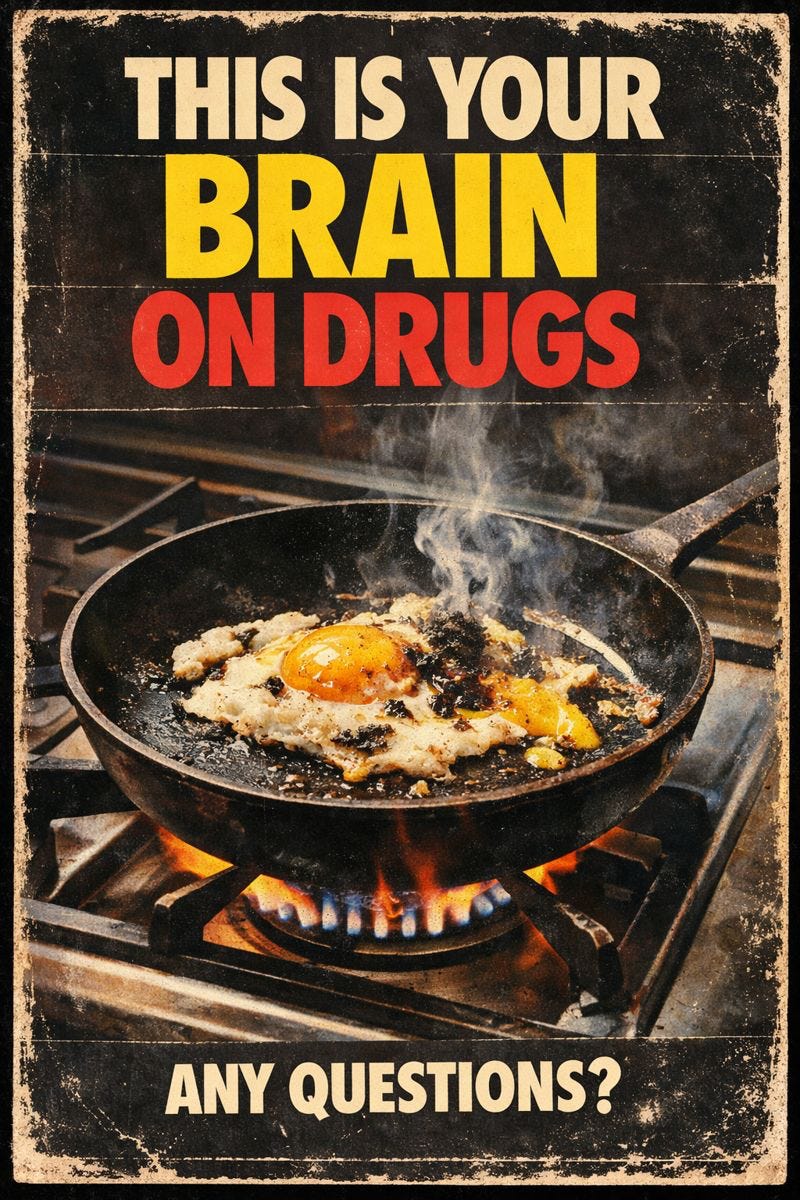
People my age will recognize “This is your brain on drugs.” That is, of course, only part of the story. There’s a lot to be said about pharmaceutical and recreational drug use that is far beyond the scope of this essay. But your goal here is to assess how you feel as a part of your framework for physical health. So, if you are using drugs of any kind, evaluate that: how are they affecting your physical functioning? Have they had their intended effect? Are the side effects worth it (and do you even know what the side effects are?) Do you need help transitioning off of them or finding a superior alternative? Your goal is to know the answer to these questions. (Please be careful about abandoning a drug protocol without the help of a physician.)
Lastly, don’t forget about your soap, shampoo, lotions, fragrances, deodorants, personal lubricants and other stuff you put on your body. Could they be making you itch? Giving you dandruff? Drying you out and making you more susceptible to cuts and infections? Introducing microplastics or heavy metals? Inform yourself about what you put on your body and whether the tradeoffs are worth it. Take care that market-leading products may be major culprits. One of the U.S.’s most popular personal lubricants, KY Jelly, has an osmolality of roughly 2000, which is about six times higher than vaginal osmolality. The consequence? Tissue damage and increased risk of disease or infection. It is estimated to own 52% of the market share in the U.S.
2. What you do with your body
I can’t wait to share more about my journey over the last year as I slowly transitioned from an athlete (in the extremely broad sense of the word) into a coach and trainer. Look for more on that next month. In the meantime, I hope you will accept the premise that I have developed some experience through my own body and helping other people tune into and improve theirs. Here’s what I have observed.
Little kids (mostly) have incredible body mechanics, with only a few evolutionary (more accurately, dysevolutionary) exceptions. Around the world, people seem to suffer from chronic back pain in particular. Some cultures are excepted. (Maybe it’s the proactive practice of yoga.) These are tied to occupational and habit patterns that undermine our natural posture and mechanics. Tie that with the burden of excess weight that can compound pressure on sensitive joints, and you have a recipe for immobility. Heck, even a person of ideal body weight who sits in a chair all day may be doomed.
The underlying issue is that bodies are meant to move, and ideally as little encumbrance as possible. Not with shoes that shift gait or stride. Not with clothing that restricts motion or forces organs to contract. Not only on rare occasions when moving between desks or meetings or other seats.
The ways that your body is used has a huge impact on how you feel, and there are probably an infinite number of ways to break down how to do that well. Based on the best thinking right now, here’s a simple way to think about how you move your body so you can design some experiments for yourself.
How much do you move all of your muscle groups (full body movements such as walking, hiking swimming, etc.)? Can you accumulate 2.5 hours per day? (Whole day, including every time you move.) This action moves blood and lymph, promotes active recovery, and non-exercise activity thermogenesis (NEAT).
How often do you raise your heart rate to between 60 and 70% of your maximum heart rate? Can you do this for 30-60 minutes 3-4 times per week?
How often do you raise your heart rate over 80% of its maximum? Can you do this 30-40 minutes per week?
How much do you sleep? Can you get 7-9 hours per night?
How much do you engage in stretching mobility exercises? Can you do 10-15 minutes per day?
These are some of the recommended ranges, but the idea is to test each one and find the right balance for yourself. To get really specific, start with baseline measurements of your resting heart rate (easiest to measure), your HRV (next easiest, with a device) and VO2 Max (can also be estimated with many devices or measured in a lab). See how those change when you get different amounts of movement and recovery.
If you are approaching the last quarter of your life, consider using the framework of a Centenarian Decathlon to set some functional longevity goals. Measure what you can do today, and shift your activity to achieve those goals over time.
After you’ve played around with these benchmarks, now consider what you really want (and need) to do with your body right now. Do you have young children or grandchildren who want you to play with them (or throw them in the pool)? Do you want to care for your home and property? You need to be able to move in lots of different ways and get enough oxygen to endure. Evaluate your fitness routine. Do your full body movements help you maintain or build muscle mass? Do they also help you build or maintain cardiorespiratory endurance? In the segment on fitness, I’ll dive into different exercise strategies and how to construct one that works for you.
3. What your body is exposed to
Environmental factors, including everything from literal climate to energy climate play an enormous role in how people feel.
It’s probably obvious that second hand smoke and smog lead to feeling poorly and generally poor health outcomes. But you may also be affected by a lack of exposure to sunlight (in winter or in cloudy climates), mold in your home, or faulty gas appliances. You may have high levels of radon in your basement. You may have bacteria growing in your sink. Or you might have mold in your humidifiers. It’s worth doing a little analysis of the things in your environment that you’re touching or breathing every day and testing whether they affect how you feel. You may have little control over some of them (e.g. loud traffic outside your door), but remember this effort is about understanding what really affects your functioning so you can decide what tradeoffs you’re willing to accept and making choices accordingly.
People are generally highly perceptive of other peoples’ energy even if they cannot name or define it. You do not have control over other peoples’ energy, and you also really don’t have direct control over your own emotional response. What you do have control over is recognizing how those things affect you and taking steps to manage them. Your boss might be a psychopath, or just a jerk. (In reality, your boss probably has shockingly low self esteem and constantly doubts their own competency, which I know is easy for me to say but trust me – I have probably worked with your boss in one way or another and you really should stop taking it personally.) Remember the people with their shoulders up literally protecting their necks? That could be you and you don’t even realize it. Try to sit down, be still, and gently scan your body from head to toe. Do you feel the tension? If you don’t intentionally release it, it just stays there until it’s forced out or it explodes.
The exercise here is to pay attention to the things in your physical and energetic environment. Can you change something and evaluate how it changes the way you feel, your energy, or your mood?
What’s Next?
After you have a sense of what you’re aiming for, or at least what you’re looking to change, you can begin to fine tune your approach to you, and over time you will develop a truly unique expertise. Being systematic will help you feel more confident, and feeling more confident will help you to be a better advocate for yourself and a more discerning participant in healthcare, fitness, and wellness offerings available to help you.
The next several essays will dig into each of these in much further detail, further unpacking the physical dimension, and then moving on to the mental, emotional and spiritual dimensions.
__
Some relevant works consulted:
Trauma, body relationship, and health outcomes
Centers for Disease Control and Prevention. About Adverse Childhood Experiences (ACEs).
Centers for Disease Control and Prevention. Sexual Violence: Prevalence and Impact in the United States.
National Institute of Mental Health. Post-Traumatic Stress Disorder (PTSD): Statistics.
U.S. Department of Veterans Affairs, National Center for PTSD. How Common Is PTSD in Adults?
Van der Kolk, B. (2014). The Body Keeps the Score. Viking.
Mind–body interaction and constructed emotion
Barrett, L. F. (2017). The Theory of Constructed Emotion. Social Cognitive and Affective Neuroscience.
Sleep, recovery, and baseline physiological needs
Watson, N. F., et al. (2015). Recommended Amount of Sleep for a Healthy Adult. Sleep.
American Academy of Sleep Medicine. Sleep Duration and Health.
Movement, fitness, and longevity
World Health Organization. (2020). Guidelines on Physical Activity and Sedentary Behaviour.
American Heart Association. Recommendations for Physical Activity in Adults.
Levine, J. A. (2004). Non-Exercise Activity Thermogenesis (NEAT). American Journal of Physiology.
Lang, J. J., et al. (2024). Cardiorespiratory Fitness as a Predictor of Mortality and Morbidity. British Journal of Sports Medicine.
Addleman, J. S., et al. (2024). Heart Rate Variability Applications in Strength and Conditioning.
Nutrition, supplementation, and experimentation
Malone, J. C., et al. (2024). Elimination Diets. StatPearls Publishing.
Subramanian, A., et al. (2024). Vitamin D Status in U.S. Adults. Journal of Nutrition.
Tian, Z., et al. (2024). Magnesium Intake and Health Outcomes. Nutrients.
Forbes, S. C., et al. (2022). Creatine Supplementation and Brain Health. Nutrients.
Coffee, alcohol, and commonly consumed substances
Ebadi, M., et al. (2021). Coffee Consumption and Liver Health. Alimentary Pharmacology & Therapeutics.
World Health Organization. (2023). No Level of Alcohol Consumption Is Safe for Health.
Topicals, lubricants, and epithelial health
Ayehunie, S., et al. (2017). Hyperosmolar Vaginal Lubricants Damage Epithelial Barrier Function. Toxicology Reports.
Environmental exposures
U.S. Environmental Protection Agency. Health Risks of Radon.
CDC / National Institute for Occupational Safety and Health (NIOSH). Mold and Health.